Moving to Spain from the US is two projects with different rules: the right to live here, which a Spanish consulate in the US decides, and the home, which you can buy as an American like anyone else. This guide puts them in order, with the official sources for every figure. For buying itself, step by step, see our guide to buying property in Spain as a foreigner.
1. Moving to Spain from the US: the short answer
- Visa first. Decide how you will live here: without working, working remotely, or working in Spain. Each has its own visa, applied for at the Spanish consulate for where you live in the US, before you move.
- The home does not give residence. The golden visa for property buyers ended on 3 April 2025 (Ley Orgánica 1/2025). A home you own can help prove your means; it is not a route on its own.
- Buying can run in parallel. An American can buy property in Spain with only an NIE and a lawyer, from the US, months before the move or after it.
- Plan the taxes on both sides. Spain taxes the home from day one; once you live here, Spain taxes your worldwide income and the US keeps taxing you as a citizen.
Rent first or buy first? Many Americans moving to Spain rent for a season to learn the area, then buy. Others reserve an off-plan new build that will be finished when they arrive. Both work; the visa is the same either way.
2. Which visa: requirements to move to Spain from the USA
As a US citizen you can visit for up to 90 days in any 180 without a visa. To live in Spain, you need a residence visa. The three routes Americans use most:
Not working: the non-lucrative visa
- Who it suits. Americans who will live on savings, a pension, rent or investments, without working.
- Money needed. At least 400% of the IPREM a month: €2,400 for you (€28,800 for the first year in 2026) and €600 for each family member (Real Decreto 1155/2024 (Reglamento de extranjería), article 62).
- Other requirements. Private health insurance, a clean criminal record (from the US, an FBI background check) and a medical certificate, with apostilles and sworn translations.
- No work. No job or business in Spain, and many consulates read it as no remote work for US clients either.
How long it takes: the immigration office decides within one month of receiving your file from the consulate, and the consulate issues the visa within one month of approval (articles 63.4 and 39.5). After five years of legal residence you can apply for long-term residence. Every document, step and renewal rule: our non-lucrative visa guide.
Working remotely for US clients: the digital nomad visa
- Who it suits. Americans who keep working remotely for employers or clients outside Spain (Ley 14/2013, articles 74 bis to 74 quinquies).
- Income needed. 200% of the Spanish minimum wage, about €2,849 a month for one person in 2026 (Real Decreto 126/2026), more for each family member.
Every requirement, step and the special 24% tax regime: our digital nomad visa guide.
Working in Spain
A job offer, highly qualified, entrepreneur or researcher permits each have their own rules. An immigration lawyer can tell you which one fits before you buy.
Where you apply. Spain has consulates general in Boston, Chicago, Houston, Los Angeles, Miami, New York, San Francisco and San Juan (Puerto Rico), and a consular section at the embassy in Washington, DC (Spanish Embassy in Washington). You apply at the one that covers the state where you live.
3. Can an American buy property in Spain?
Yes. Buying a house in Spain as a US citizen follows the same rules as for any buyer, Spanish or foreign. What you need:
- An NIE for every buyer: the foreigner’s tax number, needed for the deed and the purchase tax. A Spanish consulate in the US can issue it. Our NIE guide shows how.
- A Spanish bank account, usually a non-resident account, to pay the taxes and the bills.
- Your own lawyer, who works only for you, never the seller’s or the developer’s.
- A power of attorney if you will not fly over to sign: at a Spanish consulate in the US, or at a US notary with an apostille and a sworn translation. Limit it to this purchase. A buyer with a Spanish mortgage still sees the notary in person.
No extra tax for Americans. The 2025 proposal of a tax of up to 100% on homes bought by non-EU non-residents has not been passed. An American pays the same purchase taxes as a Spanish buyer.
4. Choosing where: the Costa del Sol for Americans
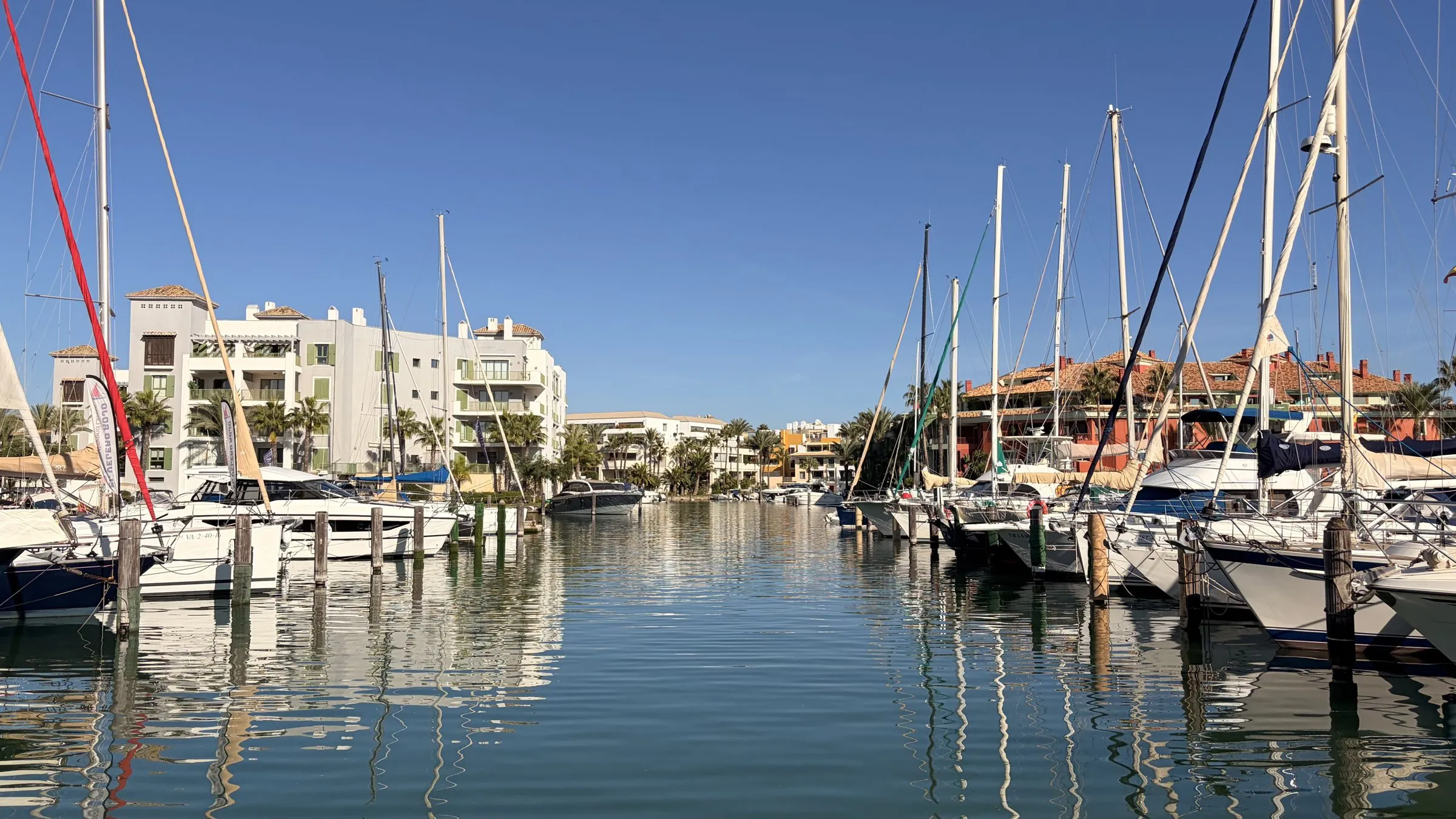
The Costa del Sol runs along the Mediterranean west and east of Málaga, with the airport next to the city. Aena’s list of destinations from Málaga airport (checked in November 2026) shows no non-stop flight to the US, so from the US you change planes on the way.
Our area guides map each town district by district, with prices per m², schools and drive times:
- Marbella: districts, new-build and resale prices and the new town plan.
- Estepona: areas, prices and drive times to Málaga and Gibraltar.
- Málaga: the city, where new homes are built and its tourist-rental rules.
- Sotogrande: from La Reserva to the marina and Torreguadiaro.
New build or resale? A new build costs more in tax (10% IVA instead of 7% transfer tax), is often paid in stages while it is built, and the developer is liable for structural defects for ten years (Ley 38/1999, article 17). A resale home can be moved into straight away, but needs a careful survey. Our development reviews show what we saw on site at each new build we visited.
5. Moving dollars: paying for the home
Homes in Spain are priced and paid for in euros. Search results for “homes for sale in Spain in US dollars” only convert the euro price at the day’s rate: the dollars you actually pay move with the rate until the last payment.
- The payments. A resale purchase usually has a deposit (often 10%) and the rest at the notary. An off-plan new build is paid in stages during construction, months apart, and each is a separate dollar-to-euro exchange.
- Each stage payment on a new build must be covered by a bank guarantee or insurance and paid into a special account, under the first additional provision of Ley 38/1999 de Ordenación de la Edificación. Check the guarantee before every transfer.
- Compare providers by the euros that arrive, not by the fee: the exchange margin is usually the larger cost.
- Source of funds. Spanish banks and notaries ask where the money comes from. Have statements ready for the sale, savings or investments behind it.
Planning, providers and bank checks: our guide to transferring money to Spain.
6. Costs of buying property in Spain
The taxes are the same for Americans as for everyone. For a €300,000 home in Andalusia, without a mortgage:
| Cost | Resale home | New build |
|---|---|---|
| Transfer tax (ITP) 7% | €21,000 | — |
| IVA 10% | — | €30,000 |
| Stamp duty (AJD) 1.2% | — | €3,600 |
| Notary | €500 – €1,000 | €500 – €1,000 |
| Land registry | €400 – €650 | €400 – €650 |
| Lawyer (1% + 21% IVA) | €3,630 | €3,630 |
| Gestoría | €300 | €300 |
| Taxes and fees | €25,830 – €26,580 (8.6–8.9%) | €38,430 – €39,180 (12.8–13.1%) |
Your own figures: the buying cost calculator works it out for any price, for a new build or a resale home, with the source of every rate. Every item is explained in our cost of buying guide.
7. Buying property in Spain: taxes as an American owner
This section covers the Spanish side. For the US side (federal returns, reporting foreign accounts and assets), ask a US tax adviser who works with Americans abroad.
While you live in the US
- Modelo 210 every year. As a non-resident from outside the EU you pay 24% on a notional income of 1.1% or 2% of the cadastral value of a home you don’t let (Real Decreto Legislativo 5/2004 (Ley del IRNR), articles 24 and 25). From 1 January 2027 these rates become a scale on the cadastral value (Real Decreto-ley 29/2026, confirmed by Congress in November 2026). How to file: our Modelo 210 guide.
- If you let the home. You pay 24% of the gross rent, with no expenses deducted; the 19% rate with expenses is only for EU and EEA residents.
- Local taxes. The yearly property tax (IBI) and the rubbish charge, set by the town. The running costs calculator estimates them.
- When you sell. The buyer keeps back 3% of the price for the tax agency, and the gain is taxed at 19% (Real Decreto Legislativo 5/2004, articles 25.2 and 25.1.f). Our guide to selling as a non-resident shows how to get the 3% back.
Once you live in Spain
- Tax-resident after 183 days. Spending more than 183 days of the calendar year in Spain, or having your main economic interests here, makes you tax-resident (Ley 35/2006 del IRPF, article 9.1). You then declare your worldwide income in Spain and stop filing the Modelo 210 for the home. The non-lucrative visa’s renewal rule uses the same 183 days.
- The US keeps taxing you. The Spain–US tax treaty (Convenio entre España y los Estados Unidos para evitar la doble imposición, 1990) lets the US tax its citizens as if the treaty did not exist (article 1.3). In return, the US allows a credit for income tax paid in Spain (article 24.2), and income the US taxes only because of citizenship counts as earned in Spain where that is needed to avoid double tax (article 24.3).
- The treaty on the home and your income. Rent and gains from a home in Spain may be taxed in Spain (articles 6 and 13.1); a private pension from past work is taxed only in the country where you live (article 20.1.a); US Social Security may be taxed by the US (article 20.1.b). The full table: our Spain–US tax treaty guide.
- Plan before you move. See advisers in both countries before the move: the date you become tax-resident is largely your choice, and it changes what you pay.
8. Healthcare and insurance
- For the visa: the non-lucrative and digital nomad visas require health insurance (Real Decreto 1155/2024, article 61.2.b; Ley 14/2013, article 62). Consulates ask for a policy with an insurer authorised in Spain, covering what the public system covers, without co-payments or waiting periods. US health plans and travel insurance are usually not accepted.
- For the home: buildings insurance is normally required by a mortgage lender and is sensible in any case. The developer’s ten-year liability covers the structure of a new build, not your belongings.
9. Buying from the US, step by step
- Search from home: areas, developments, budget with all costs. Our development reviews show what each site looks like on the ground.
- NIE, lawyer and bank account, arranged from the US.
- Site visits: a short trip, or a buyer’s agent on your side visits for you.
- Checks before any money: land registry, licences, the developer, and on a new build the bank guarantee for stage payments.
- Reservation and contract: a refundable reservation, then the purchase contract with the payment plan.
- Stage payments in euros, each covered by its guarantee.
- Completion at the notary, in person or by power of attorney.
- Handover: an inspection of the finished home before you sign the handover, with a snag list for the developer. Our handover guide shows what to check.
10. Mistakes to avoid
- Buying to get residence. It is no longer possible; choose the visa first.
- Overstaying on the 90-day rule in your own home before your visa is granted.
- Using the seller’s or the developer’s lawyer. Hire your own.
- Paying a stage without checking its bank guarantee.
- Budgeting in dollars at today’s rate for payments that fall months later.
- Forgetting the Modelo 210 in the years before you move.
- Leaving the US tax side to the last moment: the US taxes citizens wherever they live.
Checklist
- Visa route chosen (non-lucrative, digital nomad or work)
- My Spanish consulate’s document list checked
- Funds for the visa: at least €2,400 a month for me + €600 per family member
- Spanish-authorised health insurance without co-payments
- NIE for every buyer
- Own lawyer, not the seller’s or developer’s
- Spanish bank account
- Budget: price + about 13% (new build) or 9% (resale)
- Transfer provider compared by euros received
- Bank guarantee checked before each stage payment
- Power of attorney, if I won’t sign in person
- Modelo 210 diary set for every year as a non-resident
- Tax advisers in Spain and the US consulted before moving