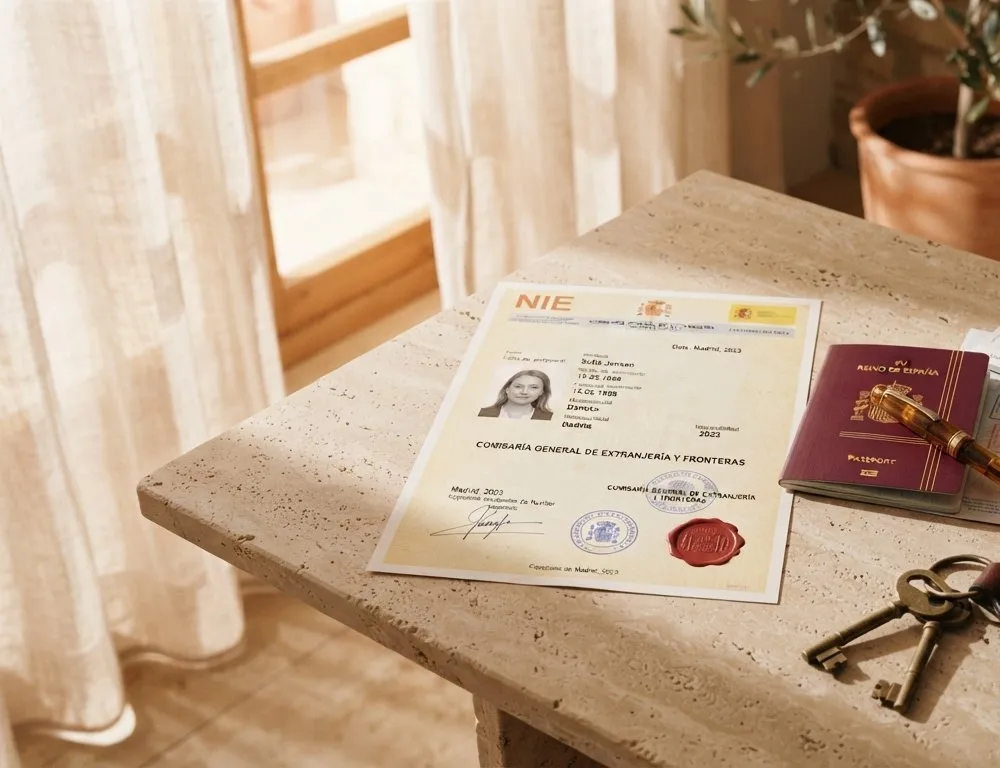
The non-lucrative residence permit (residencia temporal no lucrativa) lets a citizen from outside the EU live in Spain without working. It is set out in the immigration regulation (Real Decreto 1155/2024 (Reglamento de extranjería), articles 61 to 64). Since the golden visa ended, it is the usual route for buyers who want to live in their Spanish home.
1. Is it for you?
- Yes, if you are not an EU, EEA or Swiss citizen, you will live on savings, a pension, rent or investments, and you want to live in Spain most of the year.
- No, if you will work in Spain or keep working remotely: look at the digital nomad permit instead (see our golden visa guide, which compares the routes).
- Not needed for EU, EEA and Swiss citizens: they register as residents.
- Your family can come with you on the same route: your spouse or registered or stable partner, your children under 18, and adult children with a disability who depend on you (article 61.3).
Buying a home is not required. Since 3 April 2025 property no longer gives residence. A home you own does help: property titles are accepted as proof of your means (article 62.3).
2. How much money you need
The regulation sets the minimum as a share of the IPREM, an official index (article 62):
| Who | 2026, a month | First year |
|---|---|---|
| You (400% of the IPREM) | €2,400 | €28,800 |
| Each family member (100%) | €600 | €7,200 |
| A couple | €3,000 | €36,000 |
| A couple with two children | €4,200 | €50,400 |
- Savings or income: you can show money available for the whole period, or a regular income such as a pension, rent or dividends (article 62.1).
- How to prove it: any evidence the law accepts, including property titles, certified cheques or credit cards with a bank certificate of the available credit (article 62.3).
- Accounts abroad: the bank’s full name and address, the account numbers, the opening dates, the balance at 31 December of last year and the average balance over the last year (article 62.3).
- Shares in a company in Spain: you must certify that you do not work in it (article 62.3).
These are minimums at the date you apply for the visa or the renewal. Check the current IPREM with your consulate before you apply.
3. What else you need
Requirements in the regulation
- Health insurance (article 61.2.b).
- A passport valid for at least one year (article 38.d).
- No criminal record for offences under Spanish law in the countries where you lived in the last five years, if you are an adult (article 38.e). The foreigners’ office also checks Spain’s records and asks for a police report (article 63.3).
- A medical certificate saying you have no disease with serious public health consequences under the International Health Regulations of 2005 (article 38.i).
- The application form and the fee paid (article 38.a and h).
- You must not be in Spain irregularly, nor within a no-return period you accepted after a voluntary return home (articles 38.b and 61.2.c).
What consulates usually add
- Insurance: private health insurance with an insurer authorised in Spain, covering everything the Spanish public system covers, without co-payments or waiting periods. Travel insurance is not accepted.
- Documents from abroad: criminal record and medical certificates recent, with an apostille where needed and a sworn translation into Spanish.
- Proof that you have stopped working, at some consulates.
- Bank statements for recent months, often six to twelve. The money should be yours and available; explain any large or recent deposit, such as a gift, because money that is not explained is a common reason for refusal.
Each consulate publishes its own list and its order. Follow your consulate’s list exactly: a missing paper is the most common reason for delay.
4. How to apply, step by step
- Gather the documents above, with apostilles and translations.
- Apply at the Spanish consulate for the place where you live, before you move. The visa application includes the application for the residence permit (articles 39 and 63.1). You cannot switch to this permit from Spain as a tourist.
- The consulate checks your money and insurance; the foreigners’ office in Spain checks your record (article 39.2 and 39.3).
- Decision: the foreigners’ office decides within one month of receiving the file from the consulate. No answer in that time means refusal (article 63.4).
- The visa: if the permit is granted, the consulate issues the visa within one month (article 39.5).
- Enter Spain with the visa. It lets you live here (article 37.3).
- TIE card: apply in person at the police within one month of entering Spain (article 63.5). You will need an appointment (cita previa); book it early.
If you are refused: the refusal letter says how and by when you can challenge it, usually within one month. Often it is quicker to fix the file and apply again.
Your NIE: the foreigner’s number comes with the permit and is printed on your TIE. If you are buying first, you can get the NIE on its own; our NIE guide shows how.
5. Renewals and long-term residence
- First permit: one year (article 61.4).
- Renewal: apply at the foreigners’ office in the two months before the permit expires; that keeps your permit valid until the decision. You can still apply up to three months after it expires, but a penalty procedure may be opened (article 64.1).
- To renew you must: still have the money and the insurance, have your school-age children in school, have paid the fee and have lived in Spain for more than 183 days in the calendar year (article 64.2).
- Each renewal lasts two years (article 64.7). The office decides within three months; no answer means it is granted (article 64.8).
- After five years of legal, continuous residence you can apply for long-term residence, which lets you live and work in Spain indefinitely. Absences of up to six months at a time, and ten months in total over the five years, don’t break the five years (article 183).
You may not work
The non-lucrative permit is for people who live without working. It does not allow employment or self-employment in Spain. Many consulates read it as no remote work for employers or clients abroad either. If you will keep working, the digital nomad permit is the route.
6. Tax: you will become tax-resident
Living in Spain more than 183 days a year, which the renewal requires, makes you tax-resident in Spain (Ley 35/2006 del IRPF, article 9.1). A tax resident declares their worldwide income in Spain, including pensions, rent and investment income from abroad, and stops filing the non-resident return (Modelo 210) for the home.
Your home country may tax some of the same income. Ask a tax adviser in both countries before you move, so you know what you will pay.
7. Mistakes to avoid
- Counting on the home for residence. It helps prove your means; it does not give a permit.
- Showing too little money. The IPREM figures are minimums, for the whole year, and for every family member.
- Wrong insurance. Travel insurance, or a policy with co-payments, is refused.
- Old or untranslated documents. Check the dates, apostilles and translations your consulate asks for.
- Planning to keep working remotely. Choose the digital nomad permit instead.
- Spending too little time in Spain. Under 183 days in a year, the renewal can be refused.
- Forgetting the TIE. Apply within one month of arriving.
Checklist
- Not an EU, EEA or Swiss citizen, and will not work
- Money: at least €2,400 a month for me (€28,800 a year) + €600 a month per family member
- Bank certificates with the average balance over the last year
- Private health insurance with an insurer authorised in Spain, no co-payments
- Passport valid for at least a year
- Criminal record certificates for the last five years, apostilled and translated
- Medical certificate
- My consulate’s own document list checked
- TIE appointment booked for the first month in Spain
- Tax adviser consulted before moving