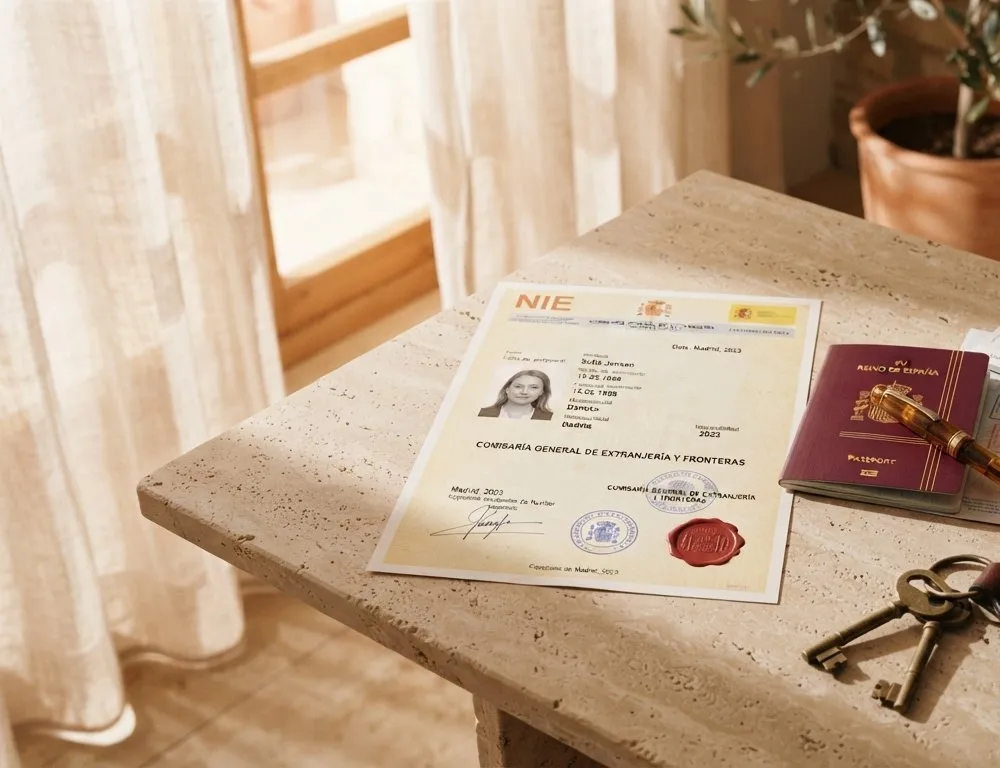
1. The golden visa is closed
The golden visa was the residence permit for investors in Ley 14/2013 de apoyo a los emprendedores y su internacionalización, articles 63 to 67. Its best-known route was buying Spanish property, but those articles were the whole residence route for investors, not only for property buyers.
Ley Orgánica 1/2025 de medidas en materia de eficiencia del Servicio Público de Justicia emptied those five articles (final provision 21). The law was published on 3 January 2025 and came into force three months later (final provision 38), so since 3 April 2025 there is no residence permit for investors in Spain, for property or for any other investment.
Watch out for old advice. Many websites, agents and developers still advertise “residency with your purchase”. It is no longer true. A purchase made today gives you a home, not a permit.
2. If you applied or already have one
The law added two transitional rules to Ley 14/2013:
- Applied before 3 April 2025? Investors and their family members who filed before that date can still receive the visa or permit under the rules in force on the day they applied (new transitional provision 1).
- Already have a golden visa? Visas and permits that were valid on that date keep their validity for the period they were issued for. A renewal is decided under the rules in force when the first permit was granted (new transitional provision 2).
In practice: if you hold a golden visa, keep the investment and the conditions you were granted under, and apply to renew in time.
3. What buying a home still does, and doesn’t
- It does not give you residence. Without a permit, a non-EU citizen can stay in the Schengen area for up to 90 days in any 180, home or no home.
- It can support another application. For the non-lucrative residence permit, you can prove your means with any evidence the law accepts, including property titles (Real Decreto 1155/2024 (Reglamento de extranjería), article 62.3). The home helps; it is not a requirement.
- It brings yearly tax. As a non-resident owner you file a tax return for the home every year. Our Modelo 210 guide explains it.
Buying is the same process for everyone: our guide to buying property in Spain as a foreigner takes you through it.
4. EU, EEA and Swiss citizens: you don’t need a visa
If you are a citizen of the EU, the EEA or Switzerland, you never needed a golden visa. To live in Spain for more than three months, you register in person at the foreigners’ office or police station of your province within three months of arriving, and show that you work in Spain, or have enough money and full health insurance, or study here. You get a registration certificate on the spot (Real Decreto 240/2007, article 7; Swiss citizens under its third additional provision).
5. The non-lucrative residence permit
For a non-EU buyer who wants to live in Spain without working, this is the usual route (Real Decreto 1155/2024, articles 61 to 64). Our non-lucrative residence guide covers every requirement and step.
What you need
- Enough money for you and your family for the whole period, without working: at least 400% of the IPREM each month for you and 100% of the IPREM for each family member (article 62). The IPREM is an official index; in 2026 it is €600 a month, so you need at least €2,400 a month (€28,800 for the one-year first permit), plus €600 a month (€7,200 a year) for each family member. Check the current figure before you apply.
- Health insurance.
- No threat to public order: the office checks for a criminal record in Spain and asks for a police report. You must also not be within a no-return period you accepted after a voluntary return home.
- The fee paid.
How it works
- Apply at the Spanish consulate for your place of residence, before you move. The visa application includes the residence permit (article 63).
- Decision: the foreigners’ office decides within one month of receiving the file from the consulate. No answer in that time means refusal.
- After you arrive: apply in person for your TIE card within one month of entering Spain.
- First permit: one year (article 61).
- Renewal: apply in the two months before it expires. You must still have the money and the insurance, have your children in school, and have lived in Spain for more than 183 days in the calendar year (article 64).
- After five years: five years of legal, continuous residence in Spain give you long-term residence, which lets you live and work here indefinitely like a Spaniard. Absences of up to six months at a time, and ten months in total, don’t break the five years (article 183).
You may not work
The non-lucrative permit is for people who live on their savings, pension or investments. It does not allow employment or self-employment in Spain. If your means come from shares in a company in Spain, you must show that you do not work in it (article 62.3). Some consulates also read it as no remote work for employers or clients abroad, and ask for proof that you have stopped working. If you will keep working remotely, the digital nomad permit is the route for you.
6. Other routes
The digital nomad permit
If you work remotely for employers or clients outside Spain, Ley 14/2013 has a permit for international teleworking (articles 74 bis to 74 quinquies):
- Who: graduates or postgraduates, or people with at least three years of professional experience.
- The work: done at a distance, for a company or companies outside Spain. Employees may only work for companies outside Spain; self-employed professionals may take Spanish clients for up to 20% of their work.
- Proof: the company has been active for at least one year, and you have worked with it for at least the last three months, with documents showing the work can be done remotely.
- Income: the law ties the money you must show to the minimum wage (additional provision 20), and the government’s instructions set it at 200% of it. The 2026 minimum wage is €1,221 a month in 14 payments, €17,094 a year (Real Decreto 126/2026 por el que se fija el salario mínimo interprofesional para 2026, articles 1 and 3), so for one person that is about €34,188 a year, €2,849 a month. More is needed for each family member: ask the consulate for the current figures.
- General requirements (article 62): health insurance with an insurer authorised in Spain (public or private), enough money for you and your family, and no criminal record in Spain or in the countries where you lived in the last two years.
- Duration: the visa lasts up to one year; from Spain you can then apply for a residence permit of up to three years, renewable for two years at a time.
Other permits
There are also permits for entrepreneurs (with a favourable report from ENISA on the business plan, article 70), highly qualified professionals, researchers and intra-company transfers, each with its own rules. An immigration lawyer can tell you which one fits your situation before you buy.
7. Think about tax before you move
Living in Spain changes your tax position. You become tax-resident in Spain if you spend more than 183 days of the calendar year here, or if the main base of your business or economic interests is here (Ley 35/2006 del IRPF, article 9.1). A tax resident declares their worldwide income in Spain, and stops filing the non-resident return for the home.
The renewal rule of the non-lucrative permit (more than 183 days a year in Spain) and the tax-residence rule use the same number of days. Plan both together with a tax adviser.
8. Mistakes to avoid
- Buying because an advert promises residency. It is no longer possible.
- Overstaying. Without a permit, the 90-in-180 rule applies even in your own home.
- Letting a golden visa lapse. Renew in time; a new one can’t be obtained.
- Planning to work on a non-lucrative permit. It doesn’t allow it.
- Forgetting the tax side. More than 183 days a year in Spain usually makes you tax-resident.
Checklist
- Ignore any offer of “residency with your purchase”
- Golden visa holders: renewal date in your calendar
- EU, EEA or Swiss: register within three months of moving
- Non-EU: means of at least €2,400 a month (400% of the IPREM), plus €600 per family member
- Health insurance
- Visa application at the consulate, before you move
- TIE card within one month of arriving
- Tax residence discussed with an adviser