1. Who has to file Modelo 210
If you own a home in Spain but are not tax-resident in Spain, you are a taxpayer of the non-resident income tax (Impuesto sobre la Renta de no Residentes, IRNR). Under the Real Decreto Legislativo 5/2004, texto refundido de la Ley del Impuesto sobre la Renta de no Residentes, two kinds of income from a Spanish home are taxed in Spain (article 13.1):
- Imputed income (renta imputada): a notional income Spain assigns to a home you keep for your own use or leave empty (article 13.1.h).
- Rental income (rendimientos del capital inmobiliario): the rent you actually receive (article 13.1.g).
You declare and pay both yourself on form Modelo 210 (article 28.1). Nobody withholds this tax for you, and no letter arrives to remind you.
The important points:
- One return per owner. Spouses or friends who own a home together each file their own Modelo 210 for their share.
- One return per home. If you own two homes, you file for each one.
- It applies even if the home earns nothing. An empty holiday home still owes imputed income tax every year.
- New builds: while a home is still under construction there is no imputed income (Ley 35/2006 del IRPF, article 85.1). It starts from the day you own a finished home.
- Not bought yet? Our guide to buying property in Spain as a foreigner takes you from the NIE to the keys.
Resident or not? You are tax-resident in Spain if you spend more than 183 days of the calendar year there, or if the main base of your business or economic interests is there (Ley 35/2006, article 9.1). Residents don’t file Modelo 210; they declare the home in their normal Spanish income tax return. If you are unsure, ask a tax adviser before your first return.
2. Imputed income: the tax on a home you don’t rent out
For the days a home is not rented out, Spain treats it as producing an income equal to a percentage of its cadastral value (valor catastral). The rule comes from article 85 of Ley 35/2006, applied to non-residents by article 24.5 of the non-resident tax law.
The percentage
- 1.1% of the cadastral value if your town’s cadastral values were revised by a general revaluation that came into force on or after 1 January 2012 (Ley 35/2006, additional provision 55, for the tax years 2023 to 2026).
- 2% in all other cases.
- No cadastral value yet? If the home has no cadastral value on 31 December, or it hasn’t been notified to you, the income is 1.1% of 50% of the higher of the price you paid and the value the tax administration has checked for other taxes.
The tax rate
- 19% if you live in another EU country, or in Iceland, Norway or Liechtenstein (EEA).
- 24% if you live anywhere else, including the United Kingdom, the United States and Switzerland.
(Real Decreto Legislativo 5/2004, article 25.1.a.)
No expenses can be deducted from imputed income: you pay on the full figure.
Only for the days you owned it and didn’t rent it
The income is worked out day by day (Ley 35/2006, article 85.1). If you bought the home in July, you only declare the days from completion to 31 December. If you rented it out for part of the year, you declare imputed income only for the other days, and the rent separately (see step 5).
Worked example
A home with a cadastral value of €120,000, in a town whose values were revised from 2012, owned all year and never rented:
| EU / EEA resident | UK, US or other resident | |
|---|---|---|
| Imputed income (1.1% × €120,000) | €1,320.00 | €1,320.00 |
| Tax rate | 19% | 24% |
| Tax for the year | €250.80 | €316.80 |
If the town’s values were not revised from 2012, the rate is 2%: imputed income €2,400, tax €456 (EU/EEA) or €576 (others).
If the same home was rented out for 61 days, imputed income is due for the other 304 days: €1,320 × 304 / 365 = €1,099.40, tax €208.89 for an EU resident. The rent is declared separately.
Owned 50/50 by a couple? Each of them declares half: €60,000 of cadastral value, €660 of imputed income and €125.40 of tax each (EU/EEA) or €158.40 each (others).
Work out your own figure: the running cost calculator does this sum for your cadastral value, with the days the home was rented. Co-owners enter their own share of the cadastral value.
3. When and how to file for imputed income
The rules for filing and paying are set by the Ministry of Economy and Finance order for Modelo 210, the Orden EHA/3316/2010.
- When. Imputed income for a year is counted on 31 December of that year (Real Decreto Legislativo 5/2004, article 27.1.c). You file and pay between 1 April and 31 December of the following year; if you pay by direct debit, the window closes on 23 December (Orden EHA/3316/2010, articles 5.b and 13.6). This window was introduced in June 2026 and applies from the 2026 income, so the return for 2026 is filed between 1 April and 31 December 2027. The return for 2025 keeps the old window: 1 January to 31 December 2026.
- Who files. The return is always in the owner’s own name (article 2.2 of the order), but a gestor, lawyer or other authorised representative can submit it online for you (article 12.1.c).
- What the form asks. Returns filed from 1 January 2027 have two new boxes: the number of days the home was at your disposal (or let) and your ownership share in per cent. Expenses deducted from rent go in a new breakdown annex.
- Draft from the tax agency. On request, the tax agency can prepare a draft return (borrador) for imputed income, one for each home (Real Decreto Legislativo 5/2004, article 28 bis). You check it and confirm it.
Three ways to file and pay
- Online with a digital certificate or Cl@ve, paying by direct debit or through a bank that collects taxes for the tax agency (Orden EHA/3316/2010, articles 12 and 13). This needs a Spanish tax number (NIE).
- Paper form printed from the tax agency’s website and paid at a collecting bank in Spain (articles 10 and 11).
- Online without a certificate, paying by bank transfer from abroad (article 14). You fill in the Modelo 210 form on the tax agency’s website and choose “A ingresar mediante transferencia bancaria desde el extranjero”. If you have no Spanish tax number, the form gives you an identification code. The form gives you the tax agency’s account and a payment reference valid for 30 days, which must go, exactly as given, in the transfer’s reference field. The return counts as filed on the day the money arrives. The transfer must come from a bank that does not collect taxes for the tax agency, which in practice means a bank abroad, and any bank charges are yours.
If you ever get a refund, it can be paid into your own bank account abroad (article 3.2).
4. Filling in the form, step by step
These steps follow the tax agency’s online Modelo 210 form as it looked in October 2026, for a home you don’t rent out. Returns filed from 2027 get new boxes, so some screens may change.
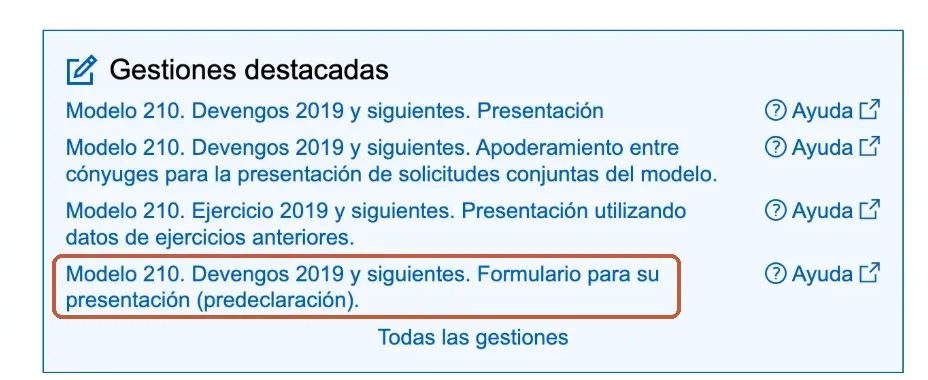
- Open the form. On the tax agency’s Modelo 210 page, choose “Modelo 210. Devengos 2019 y siguientes. Formulario para su presentación (predeclaración)”. This version works without a digital certificate.
- Persona que realiza la autoliquidación (who is filing): your Spanish tax number (NIE) and name, and tick Contribuyente. No Spanish tax number? Tick Contribuyente and use the link in the note under the name to get an identification code.
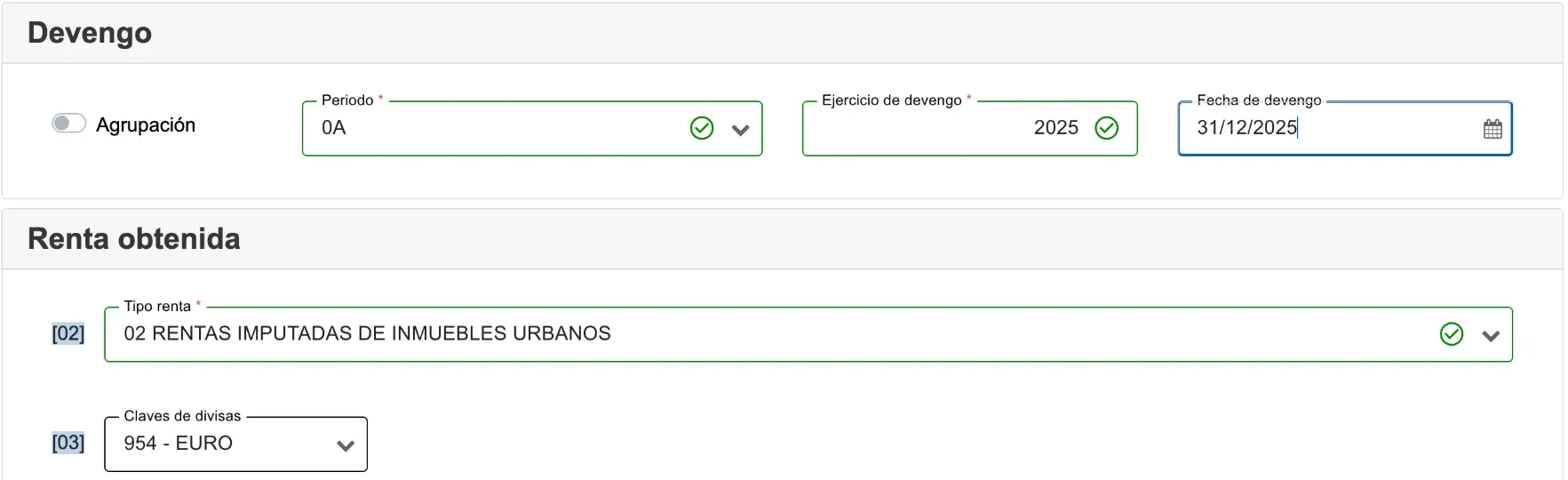
- Devengo (when the income arose): leave Agrupación off, choose 0A in Periodo, enter the year in Ejercicio de devengo and 31/12 of that year in Fecha de devengo.
- Renta obtenida (income): in box [02] Tipo renta choose 02 RENTAS IMPUTADAS DE INMUEBLES URBANOS. Box [03] stays 954 – EURO. For rent, the codes are 01, or 35 when you group rent from several tenants or guests.
-
Contribuyente (the owner): F in F/J (an individual), your name, your tax number in your own country, date and place of birth, and your country in [1] Residencia fiscal, listed by its Spanish name (REINO UNIDO, ALEMANIA, PAÍSES BAJOS…). Then your address abroad.
-
Representante: leave it empty unless you have a representative or a postal address in Spain.
-
Situación del inmueble (the property): the address and the referencia catastral (cadastral reference), copied exactly from the IBI receipt. The Buscador Catastro button helps you find it.
-
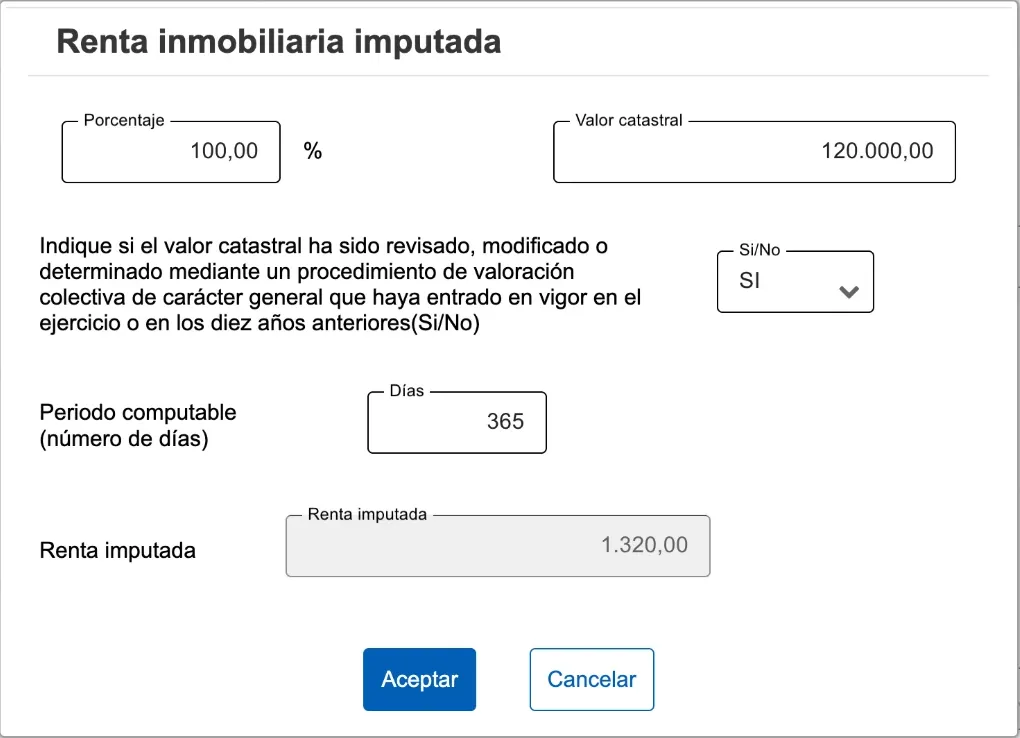
Determinación de la base imponible: press Calcular la renta inmobiliaria imputada. In the window that opens:
- Porcentaje: your ownership share (100, or 50 for each of a couple who own 50/50).
- Valor catastral: the full cadastral value of the home, not your share. The form applies your share itself.
- Sí/No: whether your town’s values were revised; read the box below before you answer.
- Días: the days you owned the home and didn’t rent it out (365 for a whole year).
The form works out the Renta imputada and, when you press Aceptar, puts it in box [04]. For a cadastral value of €120,000, Sí, 365 days and 100%, it shows €1,320.00.

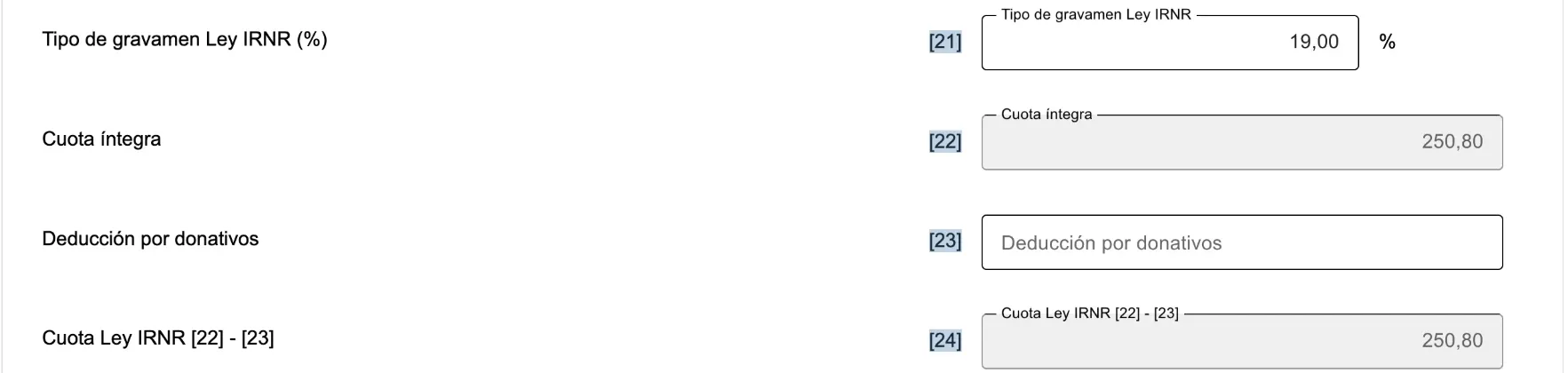
- Liquidación: leave the exemptions [19] and [20] off. Type the rate yourself in [21]: 19 if you live in the EU or EEA, 24 if you live anywhere else; the form doesn’t fill it in. Leave [23], the treaty boxes [25] to [27], [29] and [30] empty. Box [31] shows what you pay: €250.80 in our example for an EU resident.

- Validar declaración checks the return; Seleccionar Ingreso/Devolución then takes you to the payment options described in section 3. To correct a return you have already filed, tick Declaración complementaria and enter the earlier return’s Nº de justificante.
The Sí/No question still uses the old wording
The form asks whether the cadastral values were revised in a general revaluation in force “en el ejercicio o en los diez años anteriores”, in that year or the ten years before. For the tax years 2023 to 2026 the law is wider: the 1.1% rate applies if the revaluation came into force from 1 January 2012 (Ley 35/2006, additional provision 55). So for the 2025 return, if your town’s values were revised in 2012, 2013 or 2014, the 1.1% rate still applies and the answer is Sí, even though that is more than ten years back. Answering No would make you pay 2%, almost twice as much. If you are not sure when your town was revalued, ask the town hall or the Catastro.
5. Rental income: tax on the rent you receive
If you rent the home out, long-term or as a holiday let, the rent is taxed instead of imputed income for those days.
How it is taxed
- EU and EEA residents pay 19% on the rent minus the expenses directly linked to letting the home (Real Decreto Legislativo 5/2004, articles 24.6 and 25.1.a). Deductible expenses are those listed in article 23 of Ley 35/2006: for example the share of the IBI, community fees and insurance for the days rented, repairs and upkeep, mortgage interest, agency or management fees, and depreciation of up to 3% a year of the building’s value (not the land). To deduct expenses you attach a tax residence certificate from your country, valid for one year (Orden EHA/3316/2010, article 7.1).
- Everyone else, including UK residents, pays 24% on the full rent, with no expenses deducted (article 24.1).
- No reductions for non-residents. The reductions on long-term rental income that Spanish residents get do not apply to non-residents (article 24.1).
Example: a year of holiday lets
You receive €6,000 of holiday-let income over the summer. The share of expenses for the days let is €1,200.
| EU / EEA resident | UK, US or other resident | |
|---|---|---|
| Taxable amount | €6,000 − €1,200 = €4,800 | €6,000 |
| Tax rate | 19% | 24% |
| Tax for the year | €912 | €1,440 |
When to file
- The rent from one home for a whole year can go in one return, even if it came from several tenants or guests (Orden EHA/3316/2010, article 2.1.b).
- With tax to pay, you file and pay between 1 and 20 April of the following year (article 5.c.1º), or 1 to 15 April by direct debit (article 13.6).
- If expenses cancel out the rent and no tax is due, you still file, between 1 and 20 January of the following year (article 5.c.2º).
- Transition in 2026. If you declare each rent payment separately rather than for the whole year, rent received up to 30 September 2026 keeps the old quarterly deadlines: rent for July to September 2026 is due between 1 and 20 October 2026. Rent from October 2026 onwards goes in the April return.
Thinking of letting it out? See what the rent leaves you after tax with the rental yield calculator. Holiday lets also need a tourist licence, so check the rules of your town before you buy to let.
6. Filing late
Late returns cost money, but much less if you put them right before the tax agency contacts you. The rules are in the Ley 58/2003 General Tributaria:
- Filed and paid late, on your own initiative: no penalty, only a surcharge of 1% plus 1% for every full month of delay; after 12 months it is 15% plus late-payment interest (article 27.2). The surcharge is cut by 25% if you pay it in time (article 27.5).
- Found by the tax agency first: a penalty that starts at 50% of the unpaid tax (article 191), plus interest; it is reduced if you accept it and pay on time (article 188).
- A return with nothing to pay, filed late: a fixed €200, halved to €100 if you file before being asked (article 198).
So if you discover you have missed years, file them now: each year late on your own initiative costs a surcharge, not a penalty.
7. The other yearly taxes on the home: IBI and rubbish
Modelo 210 is a state tax. Your town hall charges its own:
- IBI (Impuesto sobre Bienes Inmuebles), the council property tax, worked out on the cadastral value. Each town sets its rate; for homes the basic rate is between 0.4% and 1.10% of the cadastral value (Real Decreto Legislativo 2/2004, Ley Reguladora de las Haciendas Locales, article 72.1). It is due by whoever owns the home on 1 January (article 75), and the receipt also shows your cadastral value.
- Rubbish collection (basura), a yearly municipal charge.
Residents and non-residents pay IBI and rubbish at the same rates. Set up direct debits for both: unpaid property taxes for the current and the previous year take priority over other creditors on the home itself (Ley 58/2003, article 78).
8. What changes from 2027
New imputed income scale from 1 January 2027
The Real Decreto-ley 29/2026 rewrites article 85 of Ley 35/2006 from 1 January 2027. The 1.1% / 2% split by revaluation year disappears and is replaced by a scale on the sum of the cadastral values of your homes:
- 1.1% on the first €100,000
- 1.5% from €100,000 to €500,000
- 2% from €500,000 to €1,000,000
- 3% above €1,000,000
The first returns under the new scale would be filed in 2028, for 2027. A royal decree-law must be confirmed by Congress, so this can still change, and the tax agency has not yet said how a scale on the “sum” of values will work for non-residents, who file one return per home. We will update this guide when it is settled.
9. Mistakes to avoid
- Thinking an empty home owes nothing. It does: imputed income is due every year it isn’t rented.
- Filing one return for a couple. Each owner files for their own share.
- Using 19% as a UK resident. Since Brexit, UK residents pay 24% and cannot deduct expenses.
- Filing in January for the year just ended. From the 2026 income on, the window for imputed income opens on 1 April of the following year.
- Using last year’s cadastral value. Cadastral values change; take the figure from the latest IBI receipt.
- Forgetting the year you bought or sold. You still declare the days you owned the home. The sale itself goes on a separate Modelo 210; our guide to selling as a non-resident shows how.
- Forgetting your home country. Your country of residence may tax the same income too. Double taxation treaties usually let you offset the Spanish tax; ask an adviser where you live.
Checklist
- Confirm you are not tax-resident in Spain
- Find the cadastral value on the latest IBI receipt
- Find out whether your town’s values were revised from 2012 (1.1% or 2%)
- Note the days the home was rented and the days it wasn’t
- Each owner: work out their share and file their own Modelo 210
- Imputed income: 2025 by 31 December 2026; from 2026 on, between 1 April and 31 December of the following year
- Rent: file between 1 and 20 April of the following year (1–20 January if no tax is due)
- EU/EEA residents deducting expenses: tax residence certificate and invoices ready
- IBI and rubbish paid by direct debit