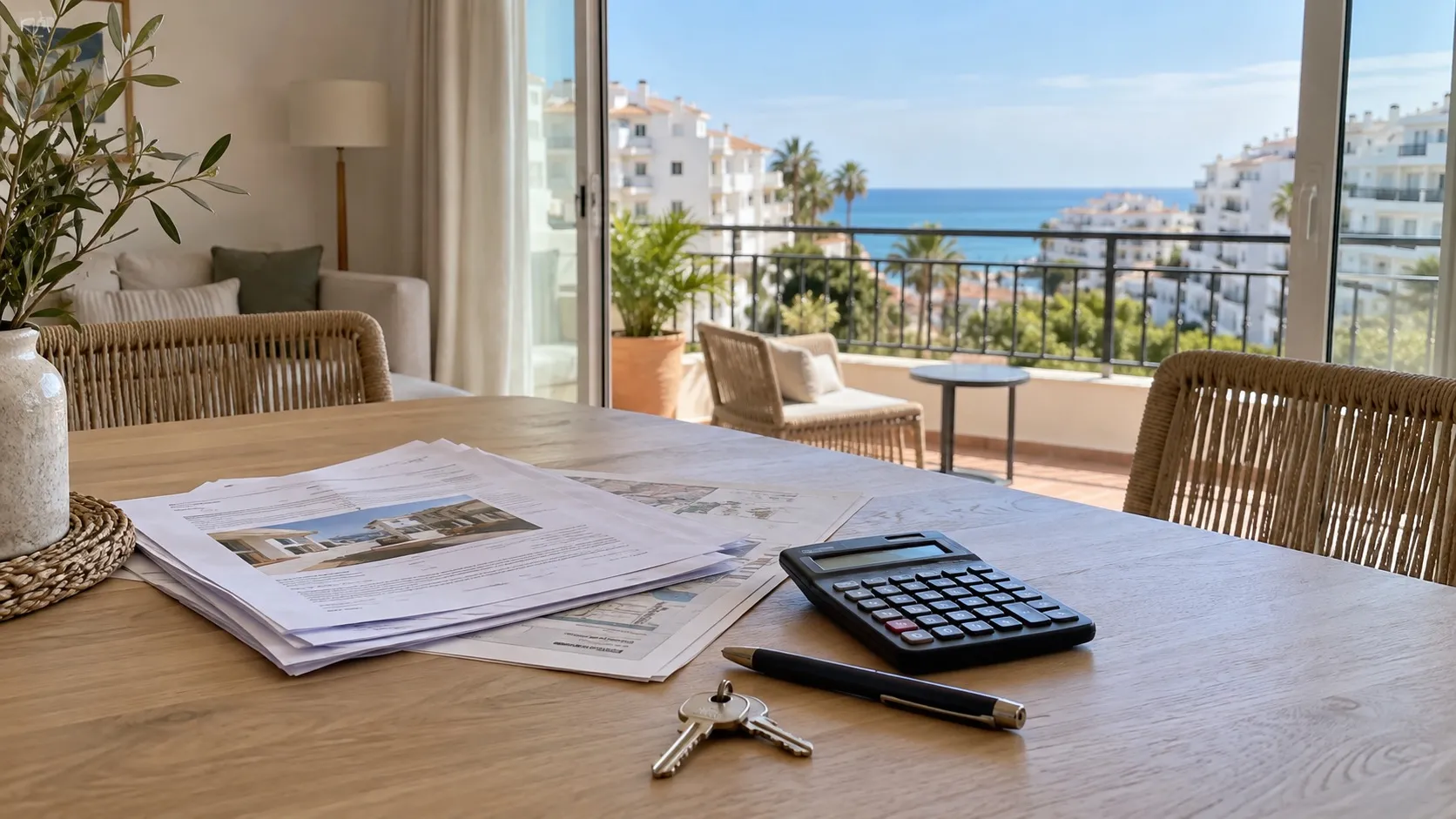
1. Can you buy, and what does buying give you?
Anyone can buy. Spain does not limit home purchases by nationality or residence. A British, American, Ukrainian or Norwegian buyer follows the same steps and pays the same purchase taxes as a Spaniard.
What buying does not give you is the right to live in Spain. The residence permit for property investors, known as the golden visa, was abolished from 3 April 2025 by Ley Orgánica 1/2025 de medidas en materia de eficiencia del Servicio Público de Justicia. Applications filed before that date are decided under the old rules, and permits already granted stay valid and can still be renewed, but a purchase today does not lead to residency. If you want to live in Spain, look at the other visas (non-lucrative, digital nomad, work) separately from the purchase: our golden visa guide explains the routes.
A non-EU citizen can also only spend 90 days in any 180 in the Schengen area without a visa. Owning a home does not change that.
2. Get your NIE
The NIE (número de identidad de extranjero) is your identity and tax number in Spain. It starts with X, Y or Z, followed by seven digits and a check letter. You need it to sign the deed, to pay the purchase tax, to open a bank account and to pay your yearly taxes. Every buyer needs one, so a couple buying together needs two.
The NIE is assigned under the foreigners regulation, Real Decreto 1155/2024 (Reglamento de extranjería), article 205, to foreigners who have economic, professional or social dealings with Spain. Buying a home is such a reason. You must state the reason when you apply.
How to apply:
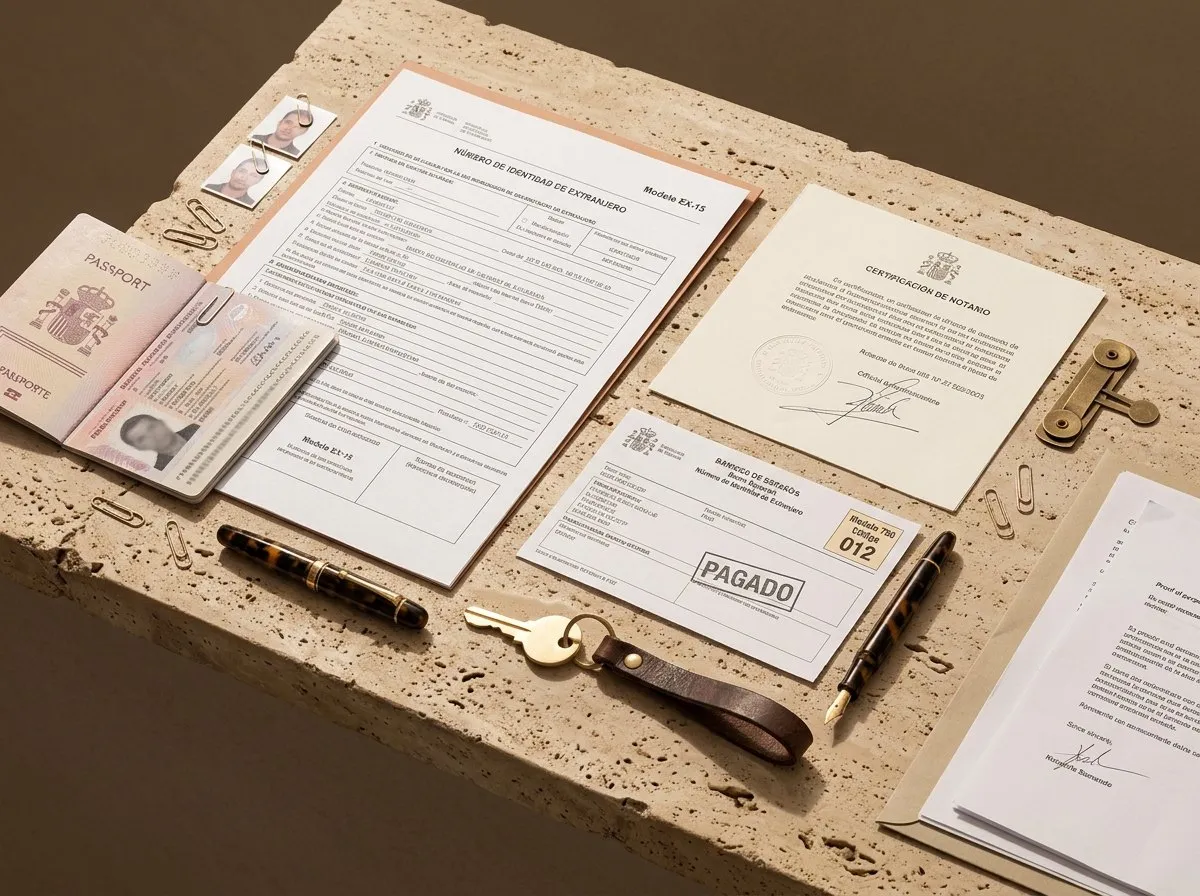
- Form EX-15, signed, with your passport and a copy, and a document that shows why you need it (for a purchase, the reservation agreement or a letter from your lawyer).
- Fee form 790, code 012, paid at a Spanish bank. The amount is set every year and the online form fills it in for you.
- Where: the regulation says you apply in person: at a Spanish consulate in your country, or in Spain at a police station or foreigners’ office (oficina de extranjería) with an appointment (cita previa).
- How long: the police must decide within five days. If you hear nothing in that time, the application counts as refused.
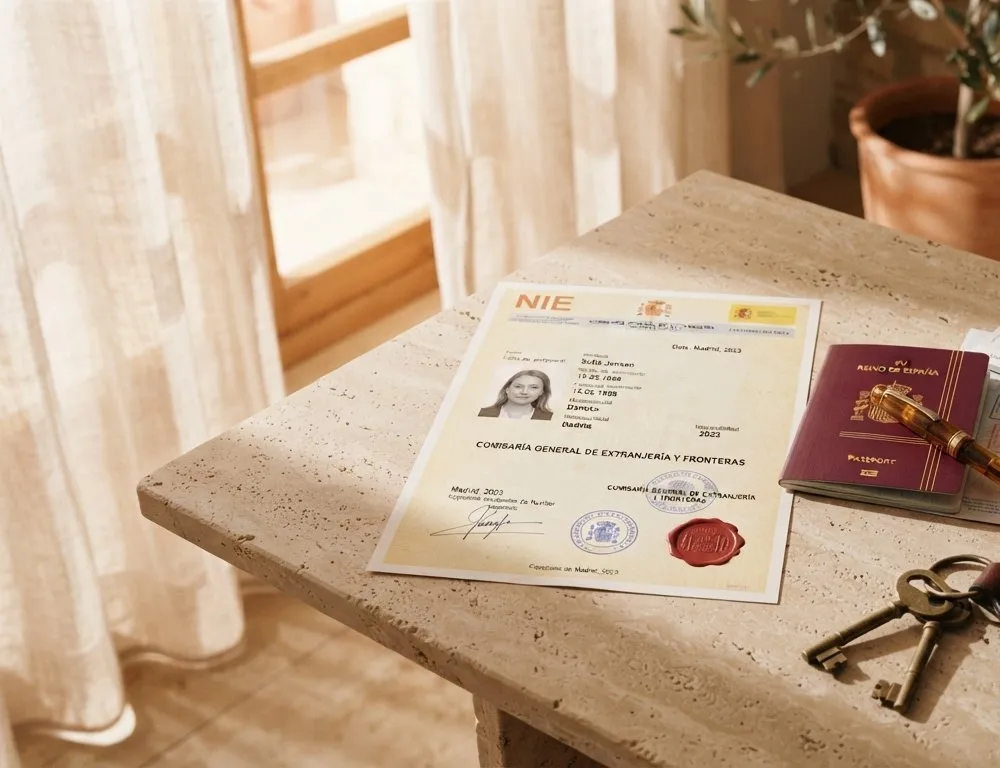
Apply early. On the Costa del Sol, police appointments for foreigners can be hard to get. The NIE is not a residence permit: the certificate only shows the number, and it does not let you live or work in Spain. Our NIE guide explains every step.
3. Open a Spanish bank account
The law does not require one, but in practice you need it:
- The property tax (IBI), the rubbish tax, the community fees, electricity and water are paid by direct debit from a Spanish account.
- Paying the price and the taxes from a Spanish account is simpler, and the notary records where every payment came from.
As a non-resident you open a non-resident account. The bank will ask for your passport, your NIE and proof of where you live and where your money comes from. Ask about the monthly fee and the cost of transfers from abroad before you choose.
Moving money from abroad: banks in Spain and in your country check the source of large transfers. Keep the paperwork that shows where the money came from (a sale, savings, an inheritance) ready. If you pay from another currency, compare your bank’s exchange rate with a specialist transfer service.
4. Hire your own lawyer
A lawyer is not compulsory, but in Spain the lawyer does the checks a surveyor or conveyancer does elsewhere. Hire one who works only for you, not one recommended by the seller or the developer.
- Cost: usually about 1% of the price plus 21% IVA. Ask for a fixed fee in writing.
- What they do: the checks in step 5, the contracts, the payment arrangements and the purchase tax.
- Power of attorney: if you can’t be in Spain, you can give your lawyer a power of attorney to sign for you. Sign it at a Spanish notary, at a Spanish consulate abroad, or at a notary in your country with an apostille and a sworn translation. Limit it to this purchase.
5. Check the property before you pay anything
These are the checks that prevent the expensive problems. Your lawyer does them, but you should know what they are.
The land registry
- The nota simple from the land registry (Registro de la Propiedad) shows the owner, any mortgage, charge or seizure, and the registered description. The seller must be the registered owner, and every charge must be cancelled at or before completion.
- The cadastre (Catastro) should match the registry and reality: the size, the use and the address.
Debts that stay with the home
- The community of owners. Unpaid community fees follow the property. Under the Ley 49/1960 sobre propiedad horizontal, article 9.1.e, the buyer answers with the home for the unpaid fees of the year of purchase and the three previous calendar years. The seller must declare that they owe nothing or say what they owe, and bring a certificate from the community’s secretary (issued within seven days of the request). Without it the notary will not authorise the deed, unless you expressly waive it. Don’t waive it.
- IBI. Ask for the last property tax receipts. Unpaid IBI is also secured on the home: the property answers for the full tax (Real Decreto Legislativo 2/2004, texto refundido de la Ley Reguladora de las Haciendas Locales, article 64.1), and the notary asks about any IBI still owed.
Licences and planning
- Is the home legal? The Costa del Sol has homes built without a licence or beyond it. Ask the town hall’s planning department (urbanismo) whether the home, its extensions and its pool have the licences they need, and whether any planning proceedings are open.
- Permission to occupy. In Andalusia, the occupation of a home is cleared with the town hall (a declaración responsable de ocupación or, for older homes, a licence of first occupation). Utility companies ask for it before a permanent supply contract (Ley 7/2021 de impulso para la sostenibilidad del territorio de Andalucía, LISTA, article 142).
- Energy certificate. A copy of the registered energy performance certificate and its label is attached to the sale contract (Real Decreto 390/2021 por el que se aprueba el procedimiento básico para la certificación de la eficiencia energética de los edificios, article 17.2). It is valid for ten years, or five if the home is rated G.
- Holiday lets. If you plan to rent to tourists, check the community and the town first. Since April 2025 a new tourist let in a building needs the community’s express approval by three fifths of the owners, who must also hold three fifths of the shares (Ley 49/1960, articles 7.3 and 17.12, as amended by Ley Orgánica 1/2025). A town licence is not guaranteed either.
Buying off-plan: protect your stage payments
From the building licence on, a developer who takes money before the home is finished must guarantee every payment, taxes included, plus legal interest, with an insurance policy or a bank guarantee (aval) in your name, and pay the money into a special account at a bank, kept apart from its other funds (Ley 38/1999 de Ordenación de la Edificación, first additional provision). The contract must name the guarantor and the account, and you receive the guarantee document when you sign.
If the home is not started or delivered on time, you first ask the developer to repay. If it hasn’t paid within 30 days, you claim from the insurer, which must pay within another 30 days. A bank guarantee lapses if you don’t claim within two years of the breach. Ask for the individual guarantee for each payment, not a promise of one.
6. Reserve the home and sign the arras contract
- Reservation. An agent may ask for a small reservation fee to take the home off the market for a few days while your lawyer does the checks. Agree in writing that it is refunded if the checks fail.
- Arras contract. Once the checks are clean, you sign the private deposit contract (contrato de arras) and pay the deposit. A common amount on the Costa del Sol is 10% of the price, but it is negotiable. The contract sets the completion deadline.
With the usual arras penitenciales (article 1454 of the Spanish Civil Code (Código Civil)), a buyer who pulls out loses the deposit, and a seller who pulls out pays back double. The contract must say clearly which kind of arras it is, so have your lawyer read it before you sign.
Buying with a mortgage? Get it approved before you sign the arras. Our guide to buying with a mortgage covers that path.
7. Work out the money you need
The price is never the full cost. Here is a €300,000 home bought without a mortgage in Andalusia:
| Cost | Resale home | New build |
|---|---|---|
| Transfer tax (ITP) 7% | €21,000 | — |
| IVA 10% | — | €30,000 |
| Stamp duty (AJD) 1.2% | — | €3,600 |
| Notary | €500 – €1,000 | €500 – €1,000 |
| Land registry | €400 – €650 | €400 – €650 |
| Lawyer (1% + 21% IVA) | €3,630 | €3,630 |
| Gestoría | €300 | €300 |
| Taxes and fees | €25,830 – €26,580 (8.6–8.9%) | €38,430 – €39,180 (12.8–13.1%) |
- Resale: the 7% is charged on the higher of the price and the cadastral reference value. Lower rates apply to some buyers of a main home (for example under 35), but not to a holiday home.
- New build: IVA is charged on the price; the 1.2% stamp duty on the higher of the price and the reference value.
- Estate agency: in Spain its fee is normally agreed with the seller. Check in writing that none of it falls on you.
Work out your own numbers: the buying cost calculator gives this breakdown for any price, for a resale home or a new build, with the source of every rate. Every tax and fee is explained in our cost of buying guide.
8. Completion at the notary
You (or your representative), the seller and the lawyers sign the deed (escritura pública de compraventa) in front of a notary. The notary is a public official who acts for neither side: they check identities, the seller’s title and the certificates, read the deed and record how the price is paid.
- Payment: usually a banker’s draft (cheque bancario) handed over at the notary, or a bank transfer the notary can verify. Agree the method with the seller’s lawyer in advance.
- Keys: handed over once the deed is signed and the price paid.
Buying from a non-resident seller
If the seller is not resident in Spain, you must hold back 3% of the price and pay it to the tax agency on the seller’s behalf with form 211 (Real Decreto Legislativo 5/2004, texto refundido de la Ley del Impuesto sobre la Renta de no Residentes, article 25.2). The municipal plusvalía tax, normally paid by the seller, falls on you as the buyer when the seller is a non-resident individual (Real Decreto Legislativo 2/2004, texto refundido de la Ley Reguladora de las Haciendas Locales, article 106.2). Your lawyer keeps both amounts back from the price. Selling yourself? See our guide to selling as a non-resident.
9. After completion
- Registration. The notary sends the deed electronically to the land registry. Registration is what protects you as the owner.
- Purchase tax. Your lawyer or gestoría files and pays the transfer tax or stamp duty (form 600 in Andalusia, under the Real Decreto Legislativo 1/1993, texto refundido de la Ley del Impuesto sobre Transmisiones Patrimoniales y Actos Jurídicos Documentados) within the legal deadline.
- Utilities and community. Move the electricity, water and community contracts into your name and set up the direct debits, including the IBI and the rubbish tax.
- Your yearly tax return. As a non-resident owner you file a tax return for the home every year, even if nobody rents it. Our Modelo 210 guide explains how much and when.
What will it cost every year? IBI, community fees, insurance and the non-resident tax. Estimate it with the running cost calculator.
10. Mistakes to avoid
- Using the seller’s or developer’s lawyer. Their job is to close the sale, not to protect you.
- Paying a deposit before the checks. Once the arras are signed, pulling out costs you the deposit.
- Forgetting the costs. About 9% on a resale home and 13% on a new build, paid from your own money.
- Ignoring the reference value. If it is higher than your price, the tax is charged on it.
- Paying for an off-plan home without a guarantee for each payment.
- Assuming the home brings residency. It no longer does.
- Forgetting Modelo 210. It is due every year, and nobody sends a reminder.
Checklist
- NIE for every buyer
- Spanish bank account open
- Independent lawyer hired, fee agreed in writing
- Power of attorney signed, if you won’t be in Spain
- Nota simple checked: owner, mortgages, charges
- Community debts certificate (not waived) and last IBI receipts seen
- Licences and occupation checked with the town hall
- Energy certificate received
- Bank guarantee for each payment (off-plan)
- Arras contract read by your lawyer, deposit paid
- Taxes and fees budgeted
- 3% and plusvalía held back if the seller is non-resident
- Deed signed, keys received
- Utilities, community and direct debits in your name
- Modelo 210 in your calendar