1. Choose the property and work out the real cost
The asking price is never the full cost. Before you make an offer, add up:
- The price of the home.
- Taxes. On a resale home in Andalusia you pay transfer tax (ITP) of 7%, charged on the higher of the price and the cadastral reference value. On a new build bought from the developer you pay IVA of 10% plus stamp duty (AJD) of 1.2% instead.
- Your lawyer, usually about 1% of the price plus 21% IVA.
- Notary, land registry and gestoría, a few hundred euros each.
- The mortgage valuation (tasación), if you take a mortgage.
- The estate agency, if one is involved. In Spain the agency’s fee is normally agreed with the seller, but check in writing whether any of it falls on you.
Here is a real example: a €300,000 resale home with a €200,000 mortgage.
| Cost | Amount |
|---|---|
| Transfer tax (ITP) 7% | €21,000 |
| Notary | €500 – €1,000 |
| Land registry | €400 – €650 |
| Gestoría | €300 |
| Lawyer (1% + 21% IVA) | €3,630 |
| Mortgage valuation | €300 – €600 |
| Taxes and fees | €26,130 – €27,180 (8.7–9.1% of the price) |
| Your own money needed (price + costs − mortgage) | €126,130 – €127,180 |
Spanish mortgages normally do not cover the taxes and fees, so you pay them from your own savings on top of the deposit. Our cost of buying guide explains each one.
Work out your own numbers: the buying cost calculator gives this breakdown for any price, new build or resale, with sources for every rate.
First purchase in Spain? Our guide to buying property in Spain as a foreigner covers the NIE, the bank account and the checks to make before you pay a deposit.
2. Get the mortgage approved first
Do this before you sign anything with the seller. If the bank says no after you have paid the arras deposit, you can lose that deposit.
What to expect from the banks
- Compare several banks. In our 2026 purchase Unicaja and Santander offered good rates, while BBVA was reluctant to lend because the buyer’s salary was not paid in euros. Conditions change, so ask each bank directly.
- Linked products lower the rate. Banks offer a discount on the interest rate (a bonificación) if you take their home insurance, life insurance or other products. Home insurance on the mortgaged property is needed anyway, but life insurance is optional. Compare the total yearly cost, not just the rate.
- Some banks want your income with them. Santander, for example, asked either to have the salary paid into its account or for a fixed monthly transfer into it.
- Credit check with the Bank of Spain. The bank will ask your permission to check your debts in the CIRBE, the Bank of Spain’s credit register. This is a normal step.
- A lot of paperwork. You will sign many documents, including the FEIN (the European standardised information sheet, which sets out the binding offer). Sign them as fast as you can: every day you wait pushes the completion date back.
- Timing from our purchase: about 3 days for a first, provisional answer, then about 2.5–3 weeks for the final approval.
- Online or in person. Depending on the bank, you sign at the branch or online.
The 10-day rule: by law (Ley 5/2019 reguladora de los contratos de crédito inmobiliario, article 14) the bank must give you the FEIN and the other loan documents at least 10 calendar days before you sign the mortgage. Before signing you must also visit a notary in person, at the latest the day before, for a free explanation of the loan (article 15). Build both into your timeline and travel plans.
Who pays for the mortgage? The bank pays the stamp duty on the mortgage deed, the notary for that deed, the land registry and the gestoría. You pay the valuation and any copies of the deed you ask for (Banco de España).
Check the monthly payment: €200,000 over 25 years at 3.03% (the average starting rate of new fixed-rate mortgages in Spain, INE, July 2026) is about €952 a month. Try your own offer in the mortgage calculator.
3. Sign the deposit contract (arras)
Once you know the bank will lend, you can sign the contrato de arras, the private deposit contract that takes the home off the market. The usual terms (arras penitenciales, article 1454 of the Spanish Civil Code (Código Civil)):
- The buyer pays a deposit. A common amount on the Costa del Sol is 10% of the price, but it is negotiable.
- The contract sets a deadline for completion.
- If the buyer does not complete in time, the seller keeps the deposit.
- If the seller does not complete in time, the seller pays the buyer back double.
Important: have your lawyer read every contract that does not come from the bank, and the arras contract above all. It must say clearly that the arras are penitential, and your lawyer should check the land registry (nota simple) for debts or charges on the home before you pay.
4. Agree the completion date
The buyer, the seller, both lawyers and the notary agree a date to sign the deed (escritura). Completion usually takes place at the same notary where the arras contract was signed.
Tell the bank the date straight away. The bank has to prepare the payment order that sends the money to the seller. You may have to sign it in person, either before completion day or on the day itself if the bank sends someone to the notary.
Watch this closely. The payment to the seller is the step most likely to go wrong. Confirm with the bank, in writing, who will sign what and when, and check again a few days before.
5. Completion day at the notary
In Spain the purchase and the mortgage are signed together, in front of a notary (notario). The notary is a public official who acts for neither side: they check identities and the seller’s title, read out the deed (escritura pública de compraventa) and record how the price is paid.
Who is in the room
On completion day at the notary
- The buyer (or a representative with a power of attorney)
- The seller (or their representative)
- The lawyers of both sides
- The notary
- Someone from the bank, or whoever the bank sends
- The estate agency, if there is one
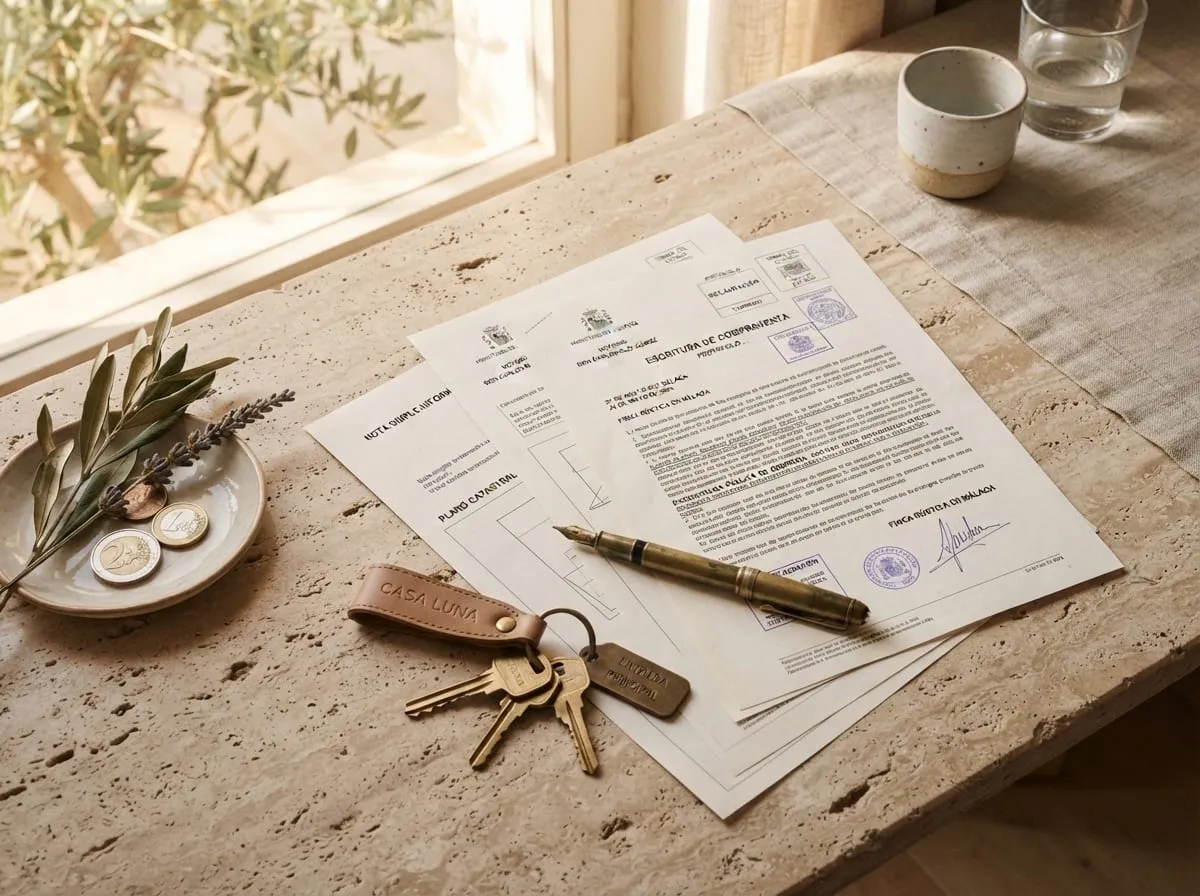
The deedEscritura pública de compraventa
Signing, payment and keys
The notary reads the deed aloud, everyone signs, the bank releases the money to the seller and you get the keys. Straight after, the notary sends the deed electronically to the Land Registry.
Ley 5/2019 • Form 600 (Andalusia)
Non-resident seller: the buyer withholds 3%
If the seller is not resident in Spain, the buyer must hold back 3% of the price and pay it to the tax agency on the seller’s behalf (form 211). Your lawyer handles this.
6. After completion
- Registration. The notary sends the deed electronically to the Land Registry, and registration is what protects you as the owner. The paper copy of the deed arrives later and is mostly a formality, but keep it safe.
- Taxes. Your lawyer or gestoría files and pays the transfer tax (form 600 in Andalusia) within the legal deadline.
- Utilities and community. Ask your agency or lawyer to contact the community of owners, the electricity and the water companies and transfer the contracts into your name. Set up direct debits for the community fees, the property tax (IBI) and the rubbish tax.
What will it cost every year? IBI, community fees, insurance and, for non-residents, tax on the home even if you don’t rent it out. Estimate it with the running cost calculator.
Checklist
- Real cost calculated: price, taxes, lawyer, notary, registry, agency
- NIE and Spanish bank account ready
- Mortgage offers from at least two banks, linked products compared
- Final mortgage approval received
- Lawyer has checked the land registry and the arras contract
- Arras signed and deposit paid
- Completion date agreed and confirmed with the bank
- Notary visit for the mortgage done (at least the day before)
- Bank payment order to the seller confirmed in writing
- Deed signed, keys received
- Utilities, community and direct debits moved into your name