Still buying the home or the plot? Start with our guide to buying property in Spain as a foreigner: the NIE, your own lawyer and the licence checks come before any building work.
1. Decide who runs the project
On a building project somebody has to own every decision, every day: what is built, at what price and by when. If you live abroad, that cannot be you on the phone. Know who does what before you start:
Who does what on a Spanish building project
- You, the promotor. The owner who pays and takes the decisions. In law it is you who commissions the project and the works.
- The architect. Designs the project and, as director de obra, directs the works. For homes the law requires an architect (Ley 38/1999 de Ordenación de la Edificación, articles 10 and 12).
- The arquitecto técnico (aparejador). Directs the execution on site and controls the quality of the work and the materials (article 13). Together with the architect, the dirección facultativa.
- The builder (constructor). Carries out the works with their own people and subcontractors. Their interest is the opposite of yours: more work, more invoices.
- A project manager (optional). Your representative. Runs the budget, the tenders, the contracts and the schedule, checks every invoice and reports to you in plain language.
The dirección facultativa answers for the technical side. The money, the deadlines and the contractors are left to you. A professional client, a company or an investor, never runs that part alone: they either have their own construction department or hire an independent project manager. For a single home, hiring is almost always cheaper than learning on your own money.
One contact, not ten. Whoever represents you, make them the only person who talks to the builder and the only one who reports to you, with a short written update and photos every week.
2. Get a complete design before you ask for prices
Most “extra works” bills start in the design, not on site. Every item missing from the drawings or the specification becomes an extra later, priced when you no longer have an alternative.
- Brief first. Write down what you want: rooms, finishes, systems (heating, air conditioning, solar, pool), budget and moving-in date. The architect designs against it.
- Execution project. Ask for a full proyecto de ejecución, not just the basic project the permit needs. It describes every item and includes the measurements (mediciones) and a budget.
- Review the design before tender. Check it against your brief, look for gaps, inconsistencies between drawings and specification, and items that are simply not described. Each one you fix now is one extra fewer later, and often a cheaper technical solution.
- Fix the specification. Brands, ranges and qualities of materials written down. “Or equivalent” with no reference is an open door.
Typical gaps: work that nobody described, such as retaining walls, connections to the water, power and sewage networks, or the outdoor works. The builder prices the drawings, and anything outside them comes back later as an extra.
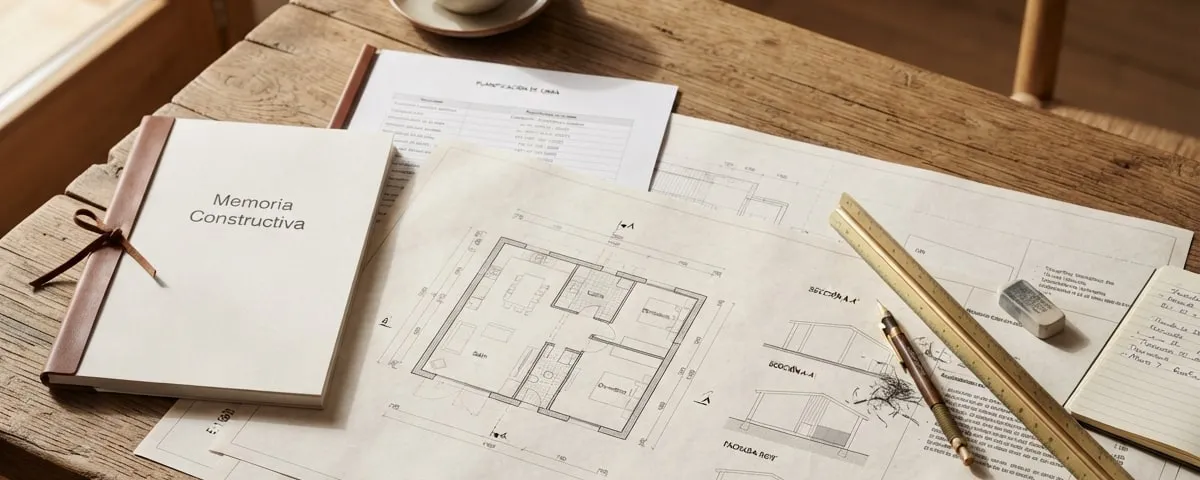
The execution projectProyecto de ejecución
Drawings, specification and measurements
A complete execution project describes every item: the drawings, the specification of materials and systems, the measurements and a budget. It is what builders price, so they all price the same works, and the reference for every extra later.
Ley 38/1999, art. 2.2
3. Compare the estimates line by line
Ask at least three builders to price the same design and the same bill of quantities. Then compare the estimates (presupuestos) line by line, not by the total. These are the three problems I find most often:
What to look for in a builder’s estimate
- Missing items. Work the project needs but the estimate leaves out. The total looks cheaper and the difference comes back as extra works. Ask every bidder to list what is excluded.
- Inflated quantities. More square metres of tiles, cubic metres of concrete or metres of pipe than the drawings need. Check the main quantities against the drawings.
- Inflated prices. Unit prices for materials and labour well above the other bids or the market. Comparing the same line across three estimates shows them at once.
Then negotiate. Go through the estimate with the builder, line by line: add what is missing, correct the quantities, challenge the prices, and agree a revised estimate. A complete estimate costs less in the end than a cheap one full of holes. On a complex mechanical and electrical installation I managed, this cut 15% off the initial construction budget, without losing quality or time.
Compare like with like: if one builder prices a different specification, ask them to reprice the reference one. Otherwise you compare different houses.
4. Sign a contract that protects the price and the deadline
- Scope and price. The contract refers to the design, the specification and the agreed estimate. What is not in them is not included, and both sides know it.
- Changes in writing. Any change, and any extra, needs a written order with its price, approved by you before the work is done. Not after.
- A schedule the builder signs. The works divided into stages with dates, agreed with you and the builder. It is the basis for the payments and for any penalty for delay.
- Payment against measured work. Pay monthly against a certificate of the work actually done (certificación de obra), not by date or on request. On a project with a dirección facultativa, the arquitecto técnico prepares and signs the certificates and the architect approves them (Ley 38/1999, articles 12 and 13). Check them against the site before you pay.
- Retention. Keep part of each payment back until the handover. A useful reference: the building law lets the promotor retain 5% of the construction cost in place of the one-year guarantee for finishing defects (article 19.1.a). Write the retention into the contract.
- Permit or declaración responsable. In Andalusia the planning law (Ley 7/2021 de impulso para la sostenibilidad del territorio de Andalucía, LISTA) decides which works need a building permit (licencia urbanística) from the town hall and which can start with a declaración responsable. Works on an existing home in urban land that change neither its footprint nor its height, and add neither floor area nor homes, can start on the day you file the declaración responsable with the project or description the works need, and so can minor works that need no project (article 138). In rustic land (suelo rústico) this route covers only minor works and energy-efficiency or renewable-energy works. Everything else, including a new home or an extension, needs the permit (article 137). The town hall has three months from a complete application to decide; if it does not answer, the permit counts as granted, but never for anything the planning rules forbid (article 140). Unless it states otherwise, a permit gives you one year to start the works and three to finish them, and a declaración responsable six months and two years; both can be extended before they run out (article 141). The permit must be shown on a sign on the site (article 143).
- Local taxes. The town hall also charges the construction tax (ICIO) and a fee for the permit. ICIO is charged on the material cost of the works, without IVA, professional fees or the builder’s profit, at a rate each town hall sets up to 4% (Real Decreto Legislativo 2/2004, Ley reguladora de las Haciendas Locales, articles 100 to 102). It is paid by you as the owner of the works. If the builder applies for the permit, they pay it and pass it on to you (article 101). It is first worked out on your budget and adjusted to the real cost at the end (article 103). Ask your town hall for the rules, rates and any reductions that apply.
5. Control the schedule and the work on site
A considered schedule is what makes a project finish on time. Agree it with the builder before work starts and follow it every week: the stages, who works on site and when, and what has to be ordered in advance.
- Track progress against the schedule, not against promises. When a stage slips, find out why the same week: missing workers, late materials, a design question nobody answered.
- Clear the way for the builder. Decisions, drawings and materials you are responsible for must arrive before the builder needs them. Most delays that come back as claims start there.
- Keep the trades in sequence. The structure, the installations and the finishes overlap. Coordinated well, the work finishes sooner. Badly coordinated, teams wait for each other and you pay for the waiting.
- Check every certificate against the measured work before you pay it, and every extra against the contract.
- Quality on site. The arquitecto técnico controls the quality of the execution. Ask for the reports and the tests, especially on the structure and the waterproofing.
Control saves time as well as money. On my projects, a schedule checked every week with the builder and the decisions taken on time made the works finish faster than when the builder was left to plan alone.
6. Handover and guarantees
- Formal handover. The works are handed over with a record (acta de recepción) signed by you and the builder, with the final certificate of the works attached. List every defect in it (snagging) with a date to fix them. If the works are not finished or do not match the contract, you can refuse the handover, giving your reasons in writing (Ley 38/1999, article 6). Release the money you held back only when the defects are fixed.
- Do not let the 30 days pass. Once the builder notifies you in writing that the works are finished, the handover counts as accepted if you raise no written reservations or refusal within 30 days, unless the contract says otherwise (article 6.4). From abroad, have someone inspect the house before that date.
- Final documents. The final certificate of the works signed by the dirección facultativa, the as-built drawings, the manuals and guarantees, and the building file (Libro del Edificio) that the law says you must receive.
- Permission to use the home. Before you move in, the occupation has to be cleared with the town hall. In Andalusia a finished home built with a permit or declaración responsable is cleared with a declaración responsable of occupation, filed with the final certificate of the works (Ley 7/2021, article 138). The utility companies ask for it before a permanent supply contract (article 142), and the notary before the deed of the finished building (additional provision nine). Check what else your town hall asks for.
- Guarantees. Counted from the handover, or from the date the defects listed in it are fixed: 1 year for finishing defects, 3 years for defects that affect habitability, 10 years for structural damage (Ley 38/1999, article 17).
- 10-year insurance. Compulsory for new homes (article 19). If you build a single house for your own use you are exempt, but if you sell it within 10 years you must take it out for the remaining years unless the buyer releases you.
What will the house cost every year? IBI, community fees if any, insurance and, for non-residents, tax on the home even if you don’t rent it out. Estimate it with the running cost calculator.
Checklist
- Brief written: rooms, finishes, systems, budget, moving-in date
- Architect and arquitecto técnico appointed
- Execution project with measurements and specification received
- Design reviewed for gaps and inconsistencies before tender
- At least three estimates on the same design and bill of quantities
- Estimates compared line by line: missing items, quantities, prices
- Revised estimate agreed with the chosen builder
- Contract signed: scope, written changes, schedule, payment against certificates
- Building permit granted or declaración responsable filed, ICIO and fees paid
- Weekly report with photos agreed
- Every monthly certificate checked against the site before payment
- House inspected within 30 days of the notice that the works are finished
- Handover record signed with the list of defects
- Final certificate, Libro del Edificio received, declaración responsable of occupation filed