For guidance on documents, legal advice and the purchase process, see our guide to buying property in Spain as a foreigner. This article focuses on assessing the property’s condition.
1. When to check the property
Arrange the inspection before signing the deposit agreement (contrato de arras), so you can discuss any defects, repairs and price adjustments with the seller before committing to the purchase.
Follow these steps:
- Before the viewing: review the documents listed in section 2.
- During the viewing: work through the checklist in section 3. Visit in daylight and bring a torch and your phone to take photos.
- If you’re considering buying: arrange a survey by an engineer before paying a deposit, or at least return for a second viewing.
A buyer of a resale home takes it as it stands. Under the Spanish Civil Code (Código Civil), the seller is not liable for obvious defects the buyer could see (article 1484), and a claim for hidden ones under this warranty has to be made within six months of handover (article 1490). It is not the only route: if the seller knew about a defect and hid it, other claims may be open, and in a home less than ten years old the developer and builders answer to later owners for structural defects (Ley 38/1999 de Ordenación de la Edificación, article 17). A lawyer can tell you which route fits your case.
2. What to check when buying a house: documents to review before the viewing
The cadastre
- You can look up the property’s recorded floor area, year of construction and use free of charge on the cadastral website (Sede Electrónica del Catastro). Search by address or cadastral reference (referencia catastral), which you’ll find on the IBI property tax receipt.
- Compare the recorded floor area with the listing If the listing gives a larger floor area, ask why. It may include an enclosed terrace or an extension that does not appear in the records.
Land registry records and documents from the seller
- The land registry extract (nota simple) identifies the registered owner and lists any mortgages or other charges on the property. You can order it online for a small fee. Your lawyer carries out the full legal checks.
- Ask for the latest IBI property tax receipt and a certificate confirming that no community fees are outstanding.
- Minutes of owners’ community meetings Review the meeting minutes (actas) from recent years to see which works have been approved and how the costs will be shared — for example, repairs to the façade, roof or lift.
- The energy performance certificate. A copy is attached to the sale contract (Real Decreto 390/2021 por el que se aprueba el procedimiento básico para la certificación de la eficiencia energética de los edificios, article 17.2). The rating provides an indication of the property’s energy performance.
3. Property viewing checklist
Complete the checklist on your phone. Your selections are saved in your browser, and any problems you flag are automatically added to a list you can copy.
- The floor area and number of rooms match cadastral records and the listing
- Any enclosed terrace, extension or storage room appears in the property records as well as the listing
- The parking space and storage room (trastero) shown at the viewing match those identified in the land registry extract
- The energy performance certificate is available and you have noted its rating
Problems found
Select ‘OK’ or ‘Problem’ for each item. Any problems you flag will appear in a list you can copy and discuss with the seller, agent or your lawyer.
Your selections are saved only in this browser.
4. Resale homes on the Costa del Sol: what to look for
Some issues are particularly common in coastal properties. They won’t affect every home, but they’re worth checking for first.
Damp and condensation
- Ground floors and north-facing rooms: stains and mould from condensation, especially in winter when the home is not aired.
- Empty homes. A property nobody has lived in for a long time often gets damp; fresh paint before a sale can hide the stains.
Sea air and sun
- Rust. Salty air eats into metal railings, fixings and outdoor air-conditioning units.
- Spalling concrete on balconies or the façade, with exposed reinforcing steel, can indicate corrosion. The community pays for the repair, and so do you: ask whether it is planned and how the cost will be shared.
Roofs, terraces and extensions
- Flat roofs and terraces (azoteas) lose their waterproofing over time. Look for leak marks on the ceilings below, including in the flat underneath.
- Glazed-in terraces and extensions are often missing from the cadastre. Raise it with the seller and your lawyer before completion: it affects taxes, the mortgage valuation and a future sale.
Building services
- Older electrics: unearthed sockets, no RCD (residual current device), not enough contracted power for air conditioning.
- Hard water: limescale on taps and scale build-up in the water heater and washing machine.
5. Checking a detached house or villa
When you buy a house or a villa, add these to the checklist:
- Roof and gutters: tiles intact, no signs of leaks in the loft or on the top-floor ceilings.
- Facade and base of the walls: cracks, damp at the base, loose render.
- A plot on a slope: retaining walls without cracks or lean, with drainage behind them.
- Pool: cracks in the shell, the pump and filter working, no water loss.
- Drainage: whether the house is on the mains sewer or has a septic tank (fosa séptica).
- Plot boundaries: whether the plot on the ground matches the cadastral plan.
- Timber: in old village houses, beams and floors checked for woodworm and termites.
6. When you find defects
- Photograph and describe every defect and note where it is. Problems you flag in the checklist above are added to a list automatically.
- Raise them before you pay a deposit: a lower price, repairs at the seller’s cost before completion, or a condition in the contract.
- Bring in your lawyer when the records do not match the property: a terrace or extension that is not recorded, or a different floor area.
- Serious signs such as cracks in load-bearing walls, leak marks on several ceilings or damp along the base of walls are a reason for a survey by an engineer before you pay anything.
7. Survey before buying a house: on your own or with an engineer
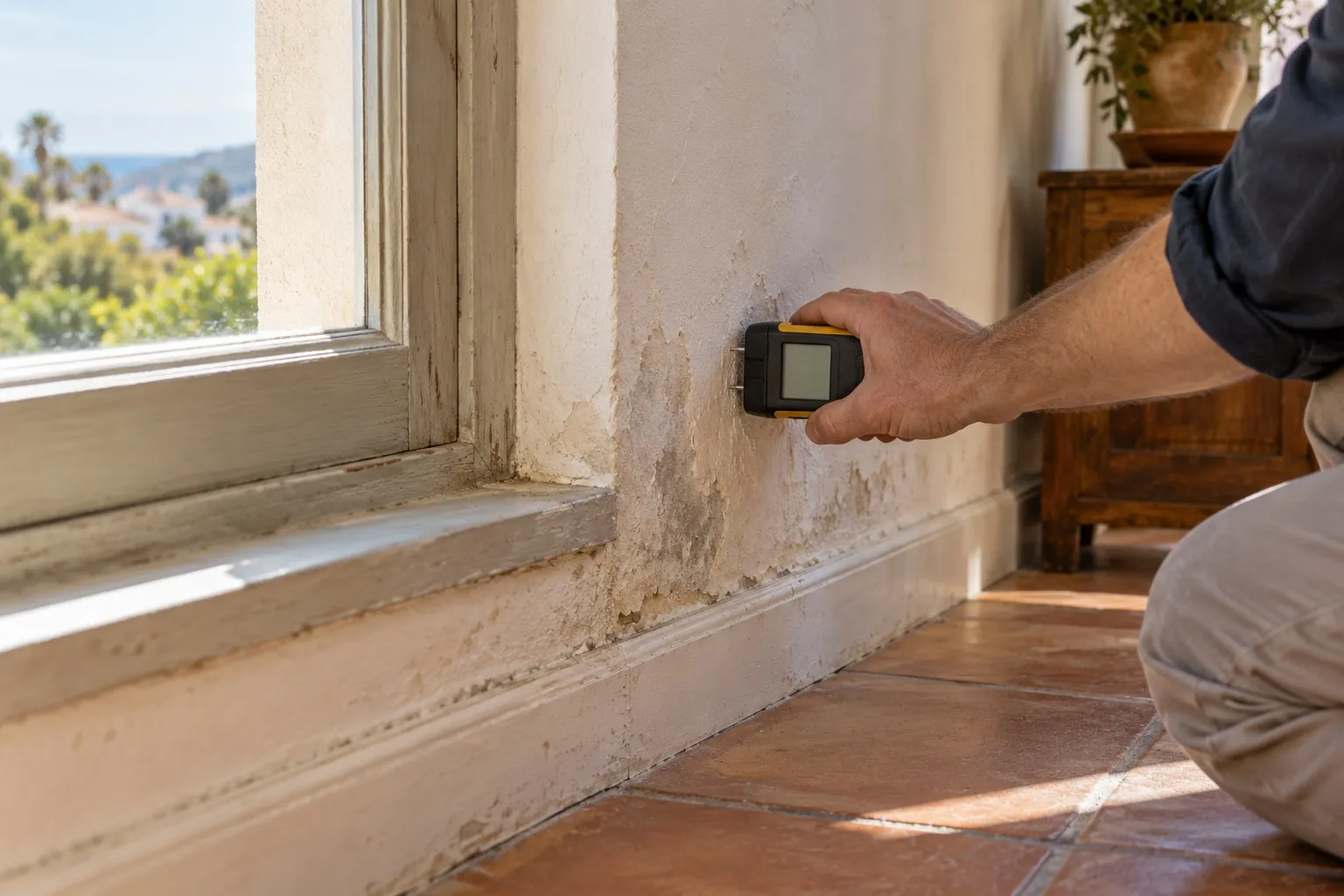
The checklist helps you spot defects during an ordinary viewing. An engineer uses specialist equipment to investigate signs of hidden problems: a moisture meter, thermal camera, socket and RCD tester, and laser level. These can help identify excess moisture, signs of leaks, overheating in the consumer unit and uneven or misaligned surfaces.
Our property survey before you buy is an inspection by an engineer with this equipment, a check against the cadastre and the land registry, a call with the main findings on the day of the inspection and a report with photos within 24 hours: in Spanish for the seller and the agent, and in English for you. Buying a new build from the developer? Read the guide to new build snagging.